

Forum Replies Created
-
AuthorPosts
-
… different terrains, powder, cords, moguls, steeps and flats, etc…
If you have experienced and know the difference in all these, I hereby dub thee a Non-Newbie!
Every mountain is going to rate their run difficulties slightly differently. There is no real official standard to it.Why do different ski areas rate so differently from others?For marketing purposes. When you are looking through a magazine or through a web site that details specifications of a ski area, the management of the ski area will attempt to tweak the percentages of runs to what type of customer they are trying to attract.You mentioned A-Basin… Perfect example. The area is one big granite cliff. Almost all black and double black diamond trails. Now there are plenty of skiers/riders who have a blast there, but typically they are locals, ski bums, or individuals. Needless to say, when you take that demographic and compare it to families, groups, and adventure seeking tourists, you can guess which one have the most money to spend. The second group ofEvery mountain is going to rate their run difficulties slightly differently. There is no real official standard to it.Why do different ski areas rate so differently from others?For marketing purposes. When you are looking through a magazine or through a web site that details specifications of a ski area, the management of the ski area will attempt to tweak the percentages of runs to what type of customer they are trying to attract.You mentioned A-Basin… Perfect example. The area is one big granite cliff. Almost all black and double black diamond trails. Now there are plenty of skiers/riders who have a blast there, but typically they are locals, ski bums, or individuals. Needless to say, when you take that demographic and compare it to families, groups, and adventure seeking tourists, you can guess which one have the most money to spend. The second group of course. For that reason, the management at A-basin (and other comparable mountains like Crested Butte, Jackson Hole, Alyeska, etc…) tweaks their maps to attract the bigger money crowd.The opposite case is true with more “rinky dink” mountains taking an obvious blue trail and marking it “black diamond”. They do it to say to the public, “Hey, we are small but we have skiing for ALL ability levels!”Don't get me wrong, I am not criticizing them or saying that they are being flat out dishonest. Many many trails are borderline and need to get designated one way or the other. Conditionals and grooming play a major role as well. When mountain management rate their trails, they do so at the advise and approval of ski patrol and reserve the right to do so.As a rider, it is your responsibility to know your ability level and survey the mountain and the conditions and decide if a trail is right for you or not. You must know “the code” and abide by it. If you are asking yourself, “What does Frosty mean by The Code?” then you better pay attention. When you buy a lift ticket you automatically agree to abide by the “Skier / Rider Responsibility Code”.Your Responsibility Code 1. Always stay in control, and be able to stop or avoid other people or objects. Part of your responsibility as a skier/snowboarder is to be in control at all times on the slopes. Be aware of your speed and the speed of those around you to maintain safe skiing on the slopes. 2. People ahead you have the right of way. It is your responsibility to avoid them.When approaching other skiers and snowboarders on the slopes, remain a clear distance from them when passing. Watch for skiers making quick turns to the right and left in front of you. Keep distance from the skier or snowboarder in front of you to allow for enough room to stop or swerve if they make a sudden turn or stop. 3. You must not stop where you obstruct a trail, or are not visible from above. If you need to take a rest or wait for friends on the slopes, select a spot on the trail where you can be clearly seen by someone approaching from above. Do not stop in the middle of a trail-move to the side. 4. Whenever starting downhill or merging into a trail, look uphill and yield to others. Keep an eye out for skiers up the hill as you enter a trail. It is your responsibility to make sure the trail is clear before entering or beginning again. 5. Always use devices to help prevent runaway equipment. Safety straps and ski stops are required to make sure a lost ski or snowboard does not injure another skier. 6. Observe all posted signs and warnings. Keep off closed trails and out of all closed areas. Obey the closed trail signs. Trails are closed due to avalanche danger, unstable conditions or exposed rocks and terrain. 7. Prior to using any lift, you must have knowledge and the ability to load, ride and unload safely. Stay within your ability and board lifts carefully and safely. Ask lift operators for help if unsure about loading and unloading procedures.Know the CodeYour Responsibility Code was established in 1966 by the National Ski Areas Association as a code of ethics for all skiers on the mountain. Today, the code reflects not only skier safety, but snowboarder and lift safety as well.In places like Colorado, the code is STATE LAW and disobeying it can get you in trouble with the law!I guess my point is that if you enter a blue run and have the attitude that “If I get hurt and I think this is out of line for what a Blue run aught to be then the resort is responsible.” then you are wrong wrong wrong.I don't like to end on a negative note, but that's all I have for now 🙂 HAVE FUN!Nice post Daniel. I would also like to add that a stance that works perfectly for one rider may not be right for another. Everyone is built differently and styles of riding make a HUGE difference in stance options. A good rule is the more comfortable and stable feeling your stance the better.Also, I would like for your Ortho guy to get in on the boards here and start a thread on injuries and we can all share our thoughts and experiences on that kind of stuff 🙂
ok thanks. yeah i think the avalanche board is way too big for me cuz i dont think i'm gonna grow much more. anyways, i was thinking about buying a used board from Play It Again Sports. I called them and they said they have a bunch of boards on sale, plus a lot of them are used to they will be cheaper. what do you think?? as long as i buy a decent brand i think it should be ok even though its used. for right now i want a board that will last me for a few years so i will be able to improve.
You take a little bit of a gamble with used stuff. It SHOULD be OK, but you still should get newer stuff (within last 3 years or so). I notice for what those places like Play-It-Again Sports get for a used rig you can get new stuff (on sale or closeout) just as cheap. When you do find your deal, do not buy simply for how good of a deal it is. Sizing is t
ok thanks. yeah i think the avalanche board is way too big for me cuz i dont think i'm gonna grow much more. anyways, i was thinking about buying a used board from Play It Again Sports. I called them and they said they have a bunch of boards on sale, plus a lot of them are used to they will be cheaper. what do you think?? as long as i buy a decent brand i think it should be ok even though its used. for right now i want a board that will last me for a few years so i will be able to improve.
You take a little bit of a gamble with used stuff. It SHOULD be OK, but you still should get newer stuff (within last 3 years or so). I notice for what those places like Play-It-Again Sports get for a used rig you can get new stuff (on sale or closeout) just as cheap. When you do find your deal, do not buy simply for how good of a deal it is. Sizing is the most important thing and board waist width is the most important spec to fit. Look for a waist of 235 to 241 mm.
1) Rossignol Scope 1572) Palmer Classic 1573) Burton Custom 156 or 158
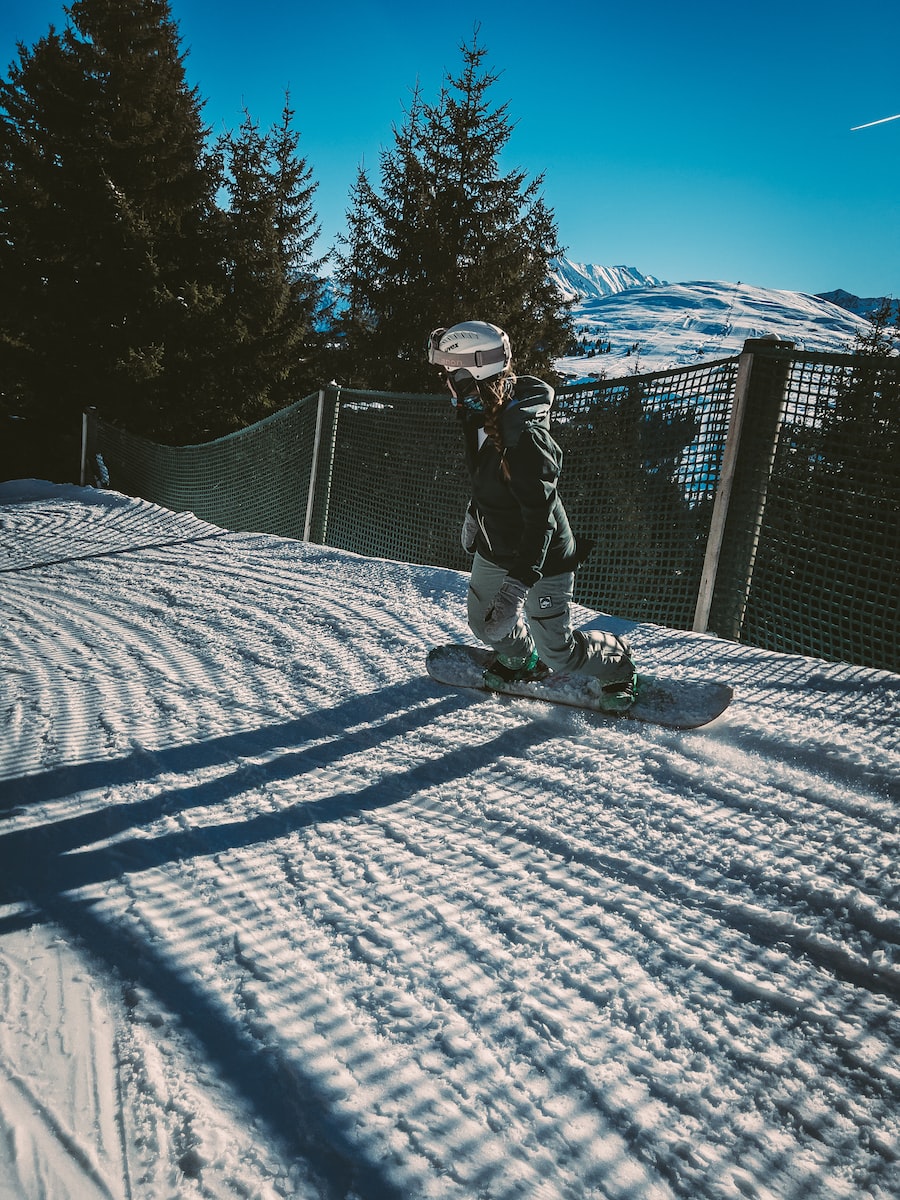
Usually these cat tracks are put into the side of a mountain and wind their way down gently. They are typically not steep at all, relatively flat. I am sure you have discovered already that flats are harder than moderately pitched runs on a snowboard, especially because it’s so easy to catch the downhill edge when the board is sideways. When these sorts of trails are cut into the mountain, they are not totally level. Kind of like with a bicycle, the key is to keep up some speed (but not too much of course) so you can balance and make your way.TO KEEP ENOUGH SPEED
On narrow cat track trails, there’s an uphill side (wall) and a downhill side (cliff). You want to ride mostly on the uphill side. This is very important since speed (momentum) is precious here. If you get stuck on the downhill side and it is too flat, you might have to frogger hop to the
Usually these cat tracks are put into the side of a mountain and wind their way down gently. They are typically not steep at all, relatively flat. I am sure you have discovered already that flats are harder than moderately pitched runs on a snowboard, especially because it’s so easy to catch the downhill edge when the board is sideways. When these sorts of trails are cut into the mountain, they are not totally level. Kind of like with a bicycle, the key is to keep up some speed (but not too much of course) so you can balance and make your way.TO KEEP ENOUGH SPEED
On narrow cat track trails, there’s an uphill side (wall) and a downhill side (cliff). You want to ride mostly on the uphill side. This is very important since speed (momentum) is precious here. If you get stuck on the downhill side and it is too flat, you might have to frogger hop to the uphill side of the trail to get going again. So balance on your uphill side edge and try to stay on the uphill side of the trail. If you are cruising nicely and you encounter a person or thing that is blocking your way there, you will have yo steer to the cliff side temporarily, go around it, keeping your speed and then back to the wall side. When you see a really flat spot coming up, evaluate ahead of time and take it with more speed than you think. That way you do not get stuck, or loose so much speed that it makes you fall over.
TO SLOW DOWN
Some of the spots on the narrow cat track are going to be a little steeper. You are going to have to take it at a speed that you are confident with. If it is a crowded area then you need to consider the comfort and safety of those around you as well. A great way to slow yourself when there is limited room it to do speed checks. They involve turning your board a certain degree sideways while still traveling forwards. To do this, use the torsional flex of your board by moving your feet to twist the board slightly. Stay light on your edge. Once the board gets mainly sideways, you can at weight and increasing edge angle (uphill edge of course) to slow you down. Then twist the other way to straighten back out. Another way to perform a speed check is to use your back leg to fan around to the side, give a little edging, then straighten out. You will find that this way is about the same as the way mentioned first, but just a different way to think about it.
What's your height and weight dude?
Thanks for joining Daniel. Great post! Straight narrow runs, although easy as pie for beginning skiers thanks to the V-shaped snowplow move (pizza vs french-fry), can be very challenging for those new to snowboarding. It takes a great deal of skill to navigate these cat track areas because they are usually so narrow. Most of the time all you want to do reduce speed, and keep from falling over or catching an edge. I will put together a few tips and put them up here in a reply.
February 2, 2008 at 6:33 pm - Views: 110 in reply to: Where is everyone going for the 2007-2008 season? #2678Im unfortunatly hitting the east coast trash ice of the south unless i can get luckyenough to get away to colorado for a week….
Sorry bout that dude, I really hope you are able to get out west soon. There is mad snow out here (I am in Oregon). We have over 170″ base right now and snow every day!
Also, see the [urlhttp://www.frostyrider.com/terms.htm]TERMS page for definition of Carve Turn[/url].
I can testify to Ride boards being very durable and long lasting compared to other brands — an attribute that is very important for heavier riders. Just my .02 🙂
Hi and welcome to the Frosty Rider Forums! I really hope you are able to get back into snowboarding. Seems like you are on a really tight budget. I don't think you can get a new setup like what you are looking for for $200, but for $299 – $360 you can get a nice new Women's board, boots, bindings package from The_House online shop.Here is a Dub TLC 149 Board, Sims Future Boot, and Dub 45 binding for under $300 http://www.the-house.com/board-packagew-01-08.htmlNo tax and free shipping = great bargainUPDATE:Also check out this package deal from Summit Online. Avalance Le Femme Style 155 board, Atlan
Hi and welcome to the Frosty Rider Forums! I really hope you are able to get back into snowboarding. Seems like you are on a really tight budget. I don't think you can get a new setup like what you are looking for for $200, but for $299 – $360 you can get a nice new Women's board, boots, bindings package from The_House online shop.Here is a Dub TLC 149 Board, Sims Future Boot, and Dub 45 binding for under $300 http://www.the-house.com/board-packagew-01-08.htmlNo tax and free shipping = great bargainUPDATE:January 30, 2008 at 12:45 am - Views: 645 in reply to: How do you know when edges need sharpening? #2665Use a fine grit sandpaper like 100 grit (or higher) or even drywall sandpaper. Store your board indoors (in house not in shed or garage) to prevent rust from forming.
For colder days, try wool or acrylic sweaters. Burton has nice wool sweaters.For warmer days, try polyester long sleeve tees. Helly Hansen makes some nice shirts.
I like mitts. Way warmer and can be relatively thinner than gloves so less bulk. You can actually push buttons on a walkie talkie and all that just as easy as with gloves. Another thing I like to do is wear a thin “spring glove” or “park glove” and wear mitten shells over them.
-
AuthorPosts
